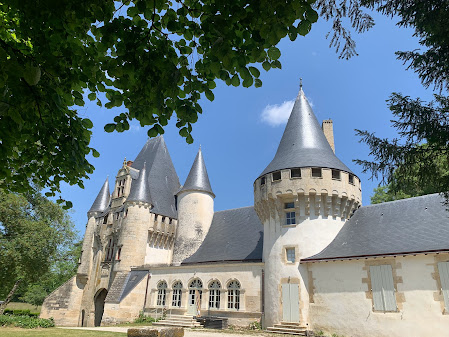
Château de Javarzay

Superstitions, mystical marks and secrets of the Château de Javarzay
It is Friday 13th October, so it seemed an appropriate date to write about some mysterious marks carved into the stonework at the Château de Javarzay and the secrets or superstitions behind them.
One of the things I enjoy most about working at the château is speaking to the visitors, both welcoming them in, and chatting about their visit afterwards. Everyone sees something different in the museum that piques their interest and whenever I’m asked a question I don’t have the answer to, I dig around until I’ve found one, and add it to my memory bank.
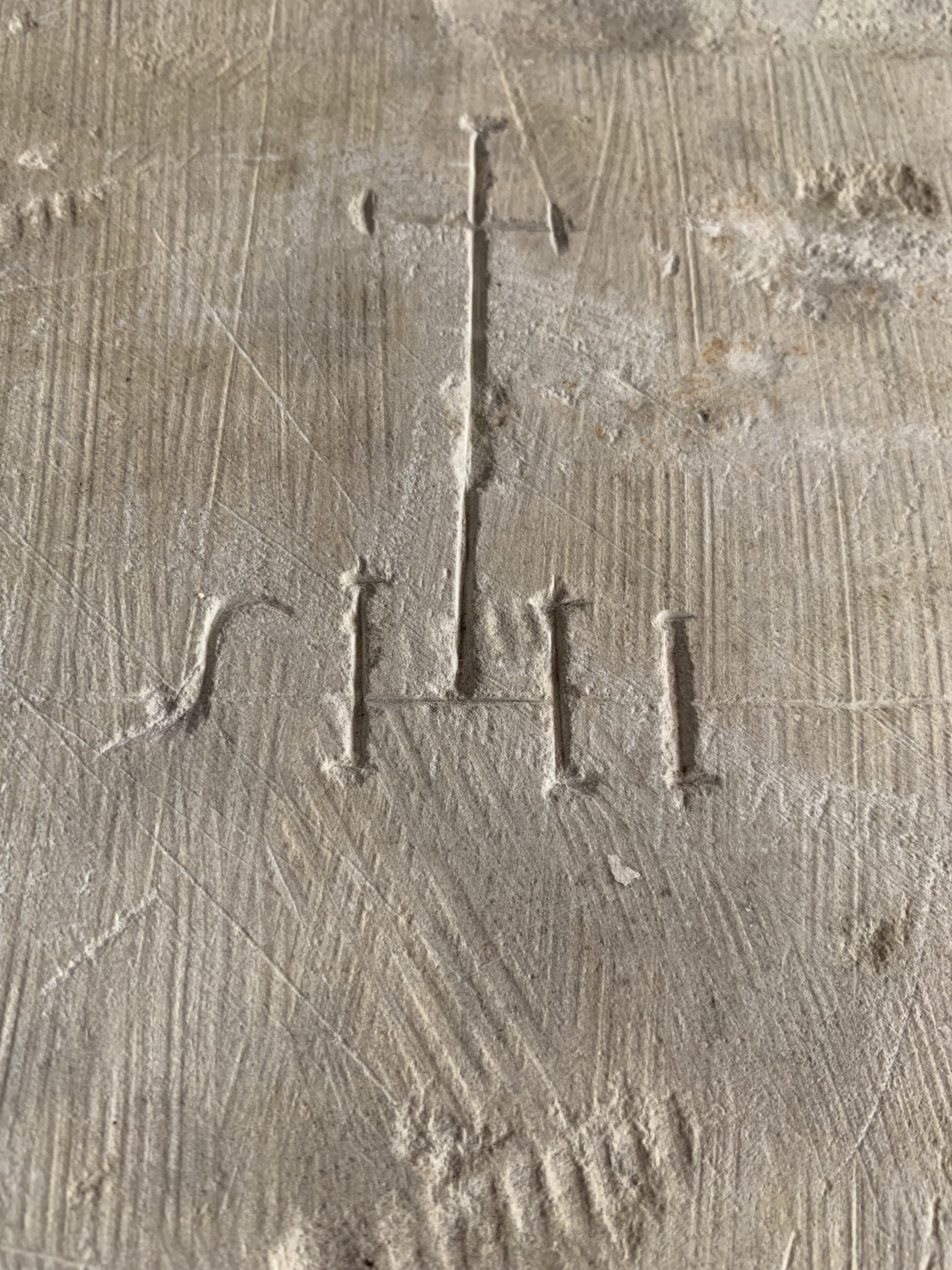
In April last year, I spotted a collection of different circular marks carved into the stonework in a window recess of the round tower. I traced them with my fingers and took photos, but it wasn’t until this September when a visitor asked what they represented and how old they were, that I thought to investigate them further.

Mysterious circular marks at the Château de Javarzay
Stonemason marks
My first point of call was to chat to some of the volunteers who’ve been part of the château since the 1980’s, and this gave me a few different answers, although like me, no one had ever given them much thought. Some believed they were stonemason’s marks, so likely dating back to the early 1500’s when the château was built, but one pointed me in the direction of a book written about another interesting property in Chef-Boutonne, Le Logis de la Pirounelle, or the alchemist’s house. More about that later.
It is not uncommon to find marks left by masons in the stonework of old buildings, either used to identify who had worked on a stone, to ensure they were paid, or to determine which stones were to be placed next to each other and which way around. This YouTube clip from the University of Warwick, that my colleague Paul found, explains this really well. The masons used a tool like a pair of compasses, but with two points, so circular designs, like the ones we have at the château are common. While this is probably the most logical explanation, I’m not convinced. We have lots of stones with no visible marks, all over the château, so why in just one window recess can we see so many different circular designs, some even carved into the same piece of stone? I guess it could have been an apprentice mason, experimenting with his tools, but my fantasy head disappeared off into another direction.

Circular markings at Château de Javarzay
The Renaissance and sacred geometry
The château dates from the early French Renaissance period, with building work beginning in 1513. The Renaissance is an era associated with artists, intellectuals and humanists, including Leonardo da Vinci, who was invited to France by King François I in 1516. As well as being given the Château Clos Lucé, in Amboise, the title of “Premier Painter and Engineer and Architect of the King” was bestowed upon him, and he remained in France until his death in 1519. One of Leonardo’s celebrated works is the Vitruvian Man, his study of the perfectly proportioned man, drawn within a circle and a square, using mathematics and geometry. This led me into the world of sacred geometry. In this ancient science, symbolic and sacred meanings are given to geometric shapes, in an attempt to explain the energy patterns that create and unify all things.

A Flower of Life?
The Seed of Life
Some of our markings look similar to the seed of life, where six circles are equally overlapped, giving the seventh, inner circle or the flower of life, six petals. We have a carving of a circle with the six petals and another of five circles within a sixth. It is the interconnecting of the circles that is one of the most important concepts of the Seed of Life, representing that we are all part of a larger, interconnected whole. Associated with the number seven, that has links to spirituality and different cultures and religions, the seed of life represents the seven stages of creation, but as more circles can be added, it also displays the concept that there is always more to create.
Mandalas, the geometric symbols that are found in both Hinduism and Buddhism, often use interconnecting circles to represent the spiritual journey, to create a focal point for meditation, or to emphasise impermanence and non-attachment. Buddhist monks will draw out elaborate mandalas as part of their worship, that are then destroyed in a fraction of the time it took to create them. Thanks to Kate at Phoenix Yoga for helping me understand this a little better.

Merkaba stone, Javarzay
Merkaba stone
If you think that these explanations are a little way out and spiritual for a five-hundred-year-old château in rural France, I’d probably agree with you if it weren’t for two things. The first is the discovery of a Merkaba stone in the sacristy of St Chartier’s church that is next door to the château. A Merkaba is an eight-pointed, three-dimensional, stone star of David that has links to Jewish mysticism but is also the energy field that surrounds our bodies. Its sacred geometric shape combines opposing energies in perfect balance and learning how to activate our Merkaba, with Prana yogic breathing, can give us a greater sense of well-being, increased intuition and a deeper connection to the universe. The Merkaba stone now lives in the round tower of the château, but my mind boggles as to how it came to be in a catholic church.

La Pirounelle, le logis de l'alchimiste
Alchemy
The second brings me back to the book by Jean-François Grimaud, about La Pirounelle, the alchemist's house, that dates from 1613. Sat on a roundabout, next to the supermarket carpark, La Pirounelle is a turreted house, partially hidden behind a high wall, that has been home to the notaires (lawyers) office, the Gendarmerie (police) but further back in time, Jean Gadouyn, an alchemist.
Alchemy is the forerunner to chemistry and the ancient science that aimed to discover how to convert metals into gold and find the elixir of life. There are many symbols associated with alchemy and carved into the stonework of La Pirounelle you can find the moon, the tree of life, a monkey, a lion and (more importantly), a six-petaled flower, just like the one at the château. Here it is said to signify to the initiated, the quest of the master of the house.

Château gallery, Dampierre-sur-Boutonne
It seems Jean Gadouyn wasn’t the only alchemist in the area as a little further along the Boutonne river, that runs behind the Château de Javarzay, is Dampierre-sur-Boutonne. Here you can find another Renaissance château, that I have now discovered is known to be an alchemist’s château. We visited it last December, and it was the elaborately carved stone ceiling on its upper gallery, that caught my eye. These carvings are a “masterpiece of French alchemical art” – Nick Inman, A Guide to Mystical France.
Wow, I had no idea that looking into a few interesting circles carved into the stonework of the château would find me dipping my toes into such deep topics, that go way above my comprehension.

Circular markings at Château de Javarzay
Apotropaic marks
Paul then came up with another possibility and I have to say, this is the one that I am drawn to the most - apotropaic marks – and no, I’d never come across that word before. These are marks that were carved into woodwork or stone, and normally found around chimneys, windows or other openings, and were believed to be charms to protect the inhabitants from witches and evil spirits. This article from the Guardian newspaper explains all and shows markings identical to what we have at the château. I wouldn’t describe it as an evil spirit, but there is definitely a ghostly presence at the château, but more about ‘her’ another day.
As Halloween approaches and our season comes to an end with a special school holiday code-breaking game, that will fill the château with mini-witches, ghosts and skeletons, on the search for sweets, I’m just hoping these marks will keep me and the château safe when sugar levels rise.
I know I have only scratched the surface here, but I have equipped myself with lots of books to delve further into this over winter, as I attempt to understand the secrets of the château a little better. One of these books, A Guide to Mystical France, by Nick Inman, who I met at a local literary festival, wisely tells me that France is full of symbols, but it is important to understand that an esoteric symbol may have no literal, fixed meaning, dealing as it does with matters that are beyond words. This is a challenge for those of us who want exact answers, but it should enable us to explore, ask questions and stretch our minds in different ways, much like the path these mysterious circles have led me on.
 |
| Some of my research reading |
Do you have any other ideas about what or why these markings are? I would love to hear from you if you do.