Pages

Showing posts with label legends. Show all posts

Saturday, January 11, 2025

Poitou-Charentes myths, legends and history - les dragons, Niort

Poitou-Charentes myths, legends and history

French Village Diaries Poitou-Charentes myths, legends, history les dragons Niort
Les dragons, Niort, summer 2024


Les Dragons, Niort


Keeping on the theme of dragons, in a similar legend to La Grand’Goule in Poitiers, our local town of Niort also has dragon tale to tell, although the slaying of this beast was rather more gruesome than the crucifix waving of Saint Radegonde in Poitiers. 


Once upon a time, roughly at the end of the 17th century, the marshlands of the Marais Poitevin and the Sèvres Niortais river were home to a gigantic, winged amphibious serpent who terrorised and carried off the Niortais people. Along came a young soldier, who had been condemned to death for desertion, but promised to kill the monster in return for a pardon. Safely protected by his suit of armour, that included a glass visor, and armed with a long spear and dagger, with a quick and agile movement, he fatally stabbed the beast in the throat. The soldier removed his visor in triumph, when the dragon, in its dying breath, spat venom and mortally poisoned him.


French Village Diaries Poitou-Charentes myths, legends, history les dragons Niort
A smaller dragon, Niort


Since 1992, four bronze dragon sculptures by Jacques Hondelatte have marked the gateway to the town centre, reminding everyone who visits Niort of the beast that once lived here. They are iconic and we have countless photos of us taken over the last twenty years, posed alongside their fanged heads that rise magnificently from the pavement. 


French Village Diaries Poitou-Charentes myths, legends, history les dragons Niort
Same cyclist, same Brompton, same dragon, different year (2019)


Saturday, January 4, 2025

Poitou-Charentes myths, legends and history - La Grand'Goule

French Village Diaries Poitou-Charentes myths, legends, history, La Grand'Goule Poitiers
La Grand'Goule, Poitiers


Poitou-Charentes myths, legends and history


La Grand’Goule


You can’t really have a series of blogs about myths and legends without talking about dragons and luckily for me, the Poitou-Charentes isn’t short of a dragon tail, or two.


When Ed moved to Poitiers for university in 2018, it gave us the opportunity to explore the city, that until then hadn’t been much more than an airport or station pick-up or drop-off zone for us. As he’s recently moved flats, we’ve been up and down a lot more than normal, and this has reignited my love for Poitiers and its rich history.


French Village Diaries Poitou-Charentes myths, legends, history, La Grand'Goule Poitiers
River Clain, Poitiers


Today’s tale is set in the watery depths of the Clain river that runs through Poitiers, and is the story of a fearsome dragon, La Grand’Goule and Sainte Radegonde, wife of Clotaire I, King of the Francs in the 6th Century, and founder of a monastery that used to sit on the site of the current Sainte-Croix Museum. The dragon was said to have used the river and a network of underground tunnels to reach the caves of the monastery, primarily to feast on the nuns. In a perfect ‘good triumphs over evil’ story, it was Sainte Radegonde who freed Poitiers from the beast, saving her nuns, and in time would become the patron saint of the city. Where prayers alone had failed to stop La Grand’Goule, when it was confronted by Radegonde, her crucifix and holy water, the beast suffered a nasty end. 


French Village Diaries Poitou-Charentes myths, legends, history, La Grand'Goule Poitiers
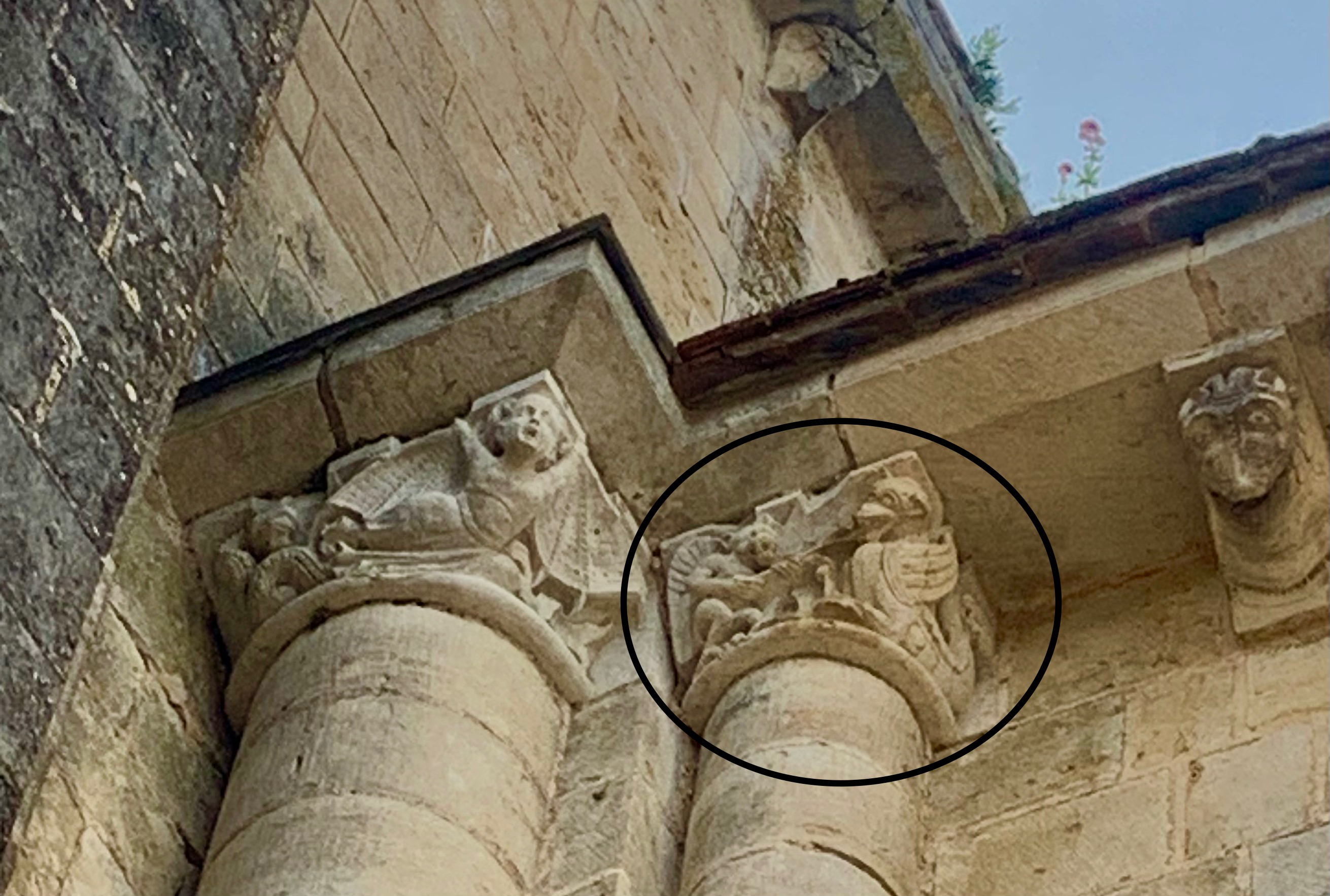
La Grand'Goule depicted in Lusignan


La Grand’Goule was gone, but not forgotten. From the 15th to 19th Centuries, an effigy of the dragon was paraded through Poitiers during the three days leading up to Ascension Day. Children would throw small cakes at it and prayers for a good harvest would be said. If you visit the Sainte-Croix Museum you can see the wooden sculpture they used, that is over three hundred years old, or look up at the water tower in the Dolmen residential area where she is painted proudly on high. Stone carvings can also be found on a number of local churches.


Having cycled along the Clain river on a misty Christmas Day afternoon, looking over to the cliffs and caves, it was easy to imagine them home to a beast of a dragon with a penchant for snacking on nuns.


Here are a few other blogs about things to enjoy in Poitiers:

Loving being a tourist in Poitiers 

Poitiers summer fun 

Poitiers insolite 


Saturday, December 21, 2024

Poitou-Charentes myths, legends and history - Devil's Bridge

French Village Diaries Poitou-Charentes myths, legends and history Pont Binot Devil's Bridge Charente
Pont Binot or Devil's bridge, Charente


Poitou-Charentes myths, legends and history

Pont Binot, or Devil’s Bridge 

I hope you are enjoying reading about the myths, legends and history of the Poitou-Charentes at least as much as I am enjoying revisiting some of my favourite places and stories. Last week it was the wells of hell, so it seemed appropriate to recount the tale of the Devil’s bridge this week. I will add links at the end to the other posts in this series, in case you have missed any.


Not far from Confolens in the Charente department, there is a stone bridge crossing the river Issoire that has featured a few times on our cycling adventures. I do have a thing for bridges and with its pale stonework glowing in the golden sunshine, and the river peacefully flowing beneath the arches, we’ve always paused to take a photo or two here. What I didn’t know until stumbling upon a podcast recently was that there has been river crossing here since Roman times and that this pretty bridge has long been known as Devil’s Bridge.


According to the legend about Pont Binot, the Devil lived a peaceful life beside the Issoire river for many years, until the locals began building a bridge. The clattering of carriage wheels over cobbles disturbed his tranquillity so much, he took action. Every evening, he hurtled across their bridge in his cart pulled by enormous beasts, destroying the construction work as their stones tumbled into the river. The villagers prayed to God and protested to the Devil, but he wouldn’t budge.


French Village Diaries Poitou-Charentes myths, legends and history Pont Binot Devil's Bridge Charente
The majestic 43-metre-high bell tower in Lesterps,
dating from the 11th century


One day, someone had the idea to use stones from an ancient, ruined abbey, ten kilometres away in Lesterps, reasoning that consecrated stones that had been blessed many times over the years might just stand up to the Devil. The stones were transported by the villagers, a new bridge was built and when it was finished, it was blessed once more, just for good measure. During a wild and stormy night, the Devil tried to demolish the bridge again, but this time to no avail. Realising he had been defeated by a more powerful force, he gave up and now sits for all eternity on the banks of the Issoire, transformed into a large rock with a rounded back (that is just about visible at the bottom left of the photo).


French Village Diaries Poitou-Charentes myths, legends and history Pont Binot Devil's Bridge Charente
The large rock said to be the devil
 

While it is true that there are many similar stories to this, about different bridges in different locations in France, there is something special about this almost hidden bridge that I think makes it worthy of a legend. Although I do have to acknowledge that as this current bridge only dates from the nineteenth century, maybe the Devil did eventually get his revenge on the original bridge. I guess we will never know.


A stone’s throw from the Devil’s bridge is the tourist site of Coriobona. Built by the Gaulois d’Esse Association, it is a reconstruction of the buildings and objects of a life-size, small, fortified Gaulois settlement, that enables visitors to discover the history of the Lémovices, a Gallic people from the Limousin who date back over two thousand years. Sadly, much as I love associations like this who bring history to life, we have not yet had the opportunity to visit. Its opening times are rather limited and seem to clash with my work at the Château de Javarzay. 


French Village Diaries Poitou-Charentes myths, legends and history Pont Binot Devil's Bridge Charente Romans
Map of France showing Roman towns 


As for the Romans, who invaded the lands of the Gaul’s, giving rise to the Gallo-Roman period of French history, we live within a triangle of Poitiers (Limonum) to the north, Saintes (Mediolanum Santonum) to the southwest and Limoges (Augustoritum) to the southeast. The Romans built roads connecting these towns to each other and onto Lyon (Lugdunum) in the east, on the Voie d’Agrippa. It is therefore no surprise that they were the first to create a river crossing at this site and that we don’t have to go too far from home to find vestiges of Roman life in the Poitou-Charentes. In fact, long before the Renaissance château was built at Javarzay, it was the site of a Gallo-Roman farm, called Gavarciacum, the domain that belonged to Gavarcus – which is where the name Javarzay originates from. 


French Village Diaries Poitou-Charentes myths, legends and history Pont Binot Devil's Bridge Charente Romans
Roman amphitheatre Saint-Cybardeaux, Charente


Our travels by bike this year, although more limited than previous years, have still taken us to huge amphitheatres, the remains of villas and an impressive underground aqueduct that supplied water to Saintes. 


French Village Diaries Poitou-Charentes myths, legends and history Pont Binot Devil's Bridge Charente
Roman underground aqueduct, Charente-Maritime


To discover more about Roman life in our area, I can recommend a visit to the fascinating Ruaranum museum in Rom. Situated in what is now a small rural village of a few hundred inhabitants, it was once a major stopover town and home to over four thousand people, as well as commerces, trades and the all-important Roman baths – part of which can still be seen. This gem of a museum houses an array of artifacts found during local archaeological digs, as well as maps and explanations of life in the Roman empire and for a small village, was a huge surprise. There are also arial photographs showing traces of the Roman buildings that can still be seen in the farmland today, revealing just how large and important Rom or Ruaranum was.


Links to previous posts: 


Le puits d’enfer 

La Jungle 

La Dame de Chambrille 

Jean-François Cail 

La fée Mélusine 

The cries through the fog 

Whooping cough, headdresses and heartthrobs 


I hope you all have a lovely Christmas however and wherever you celebrate. Without Mini, ours will be different this year, plus Ed has just moved flats, so Christmas preparations were overtaken by packing, lists and flat-pack furniture building this week, but we will be spending Christmas Day together, in his new flat, enjoying family time and simple, homemade food (so long as the new oven arrives and I can work out how to use it). Wish me luck!

Saturday, December 14, 2024

Poitou-Charentes myths, legends and history - Le puits d'enfer

French Village Diaries Poitou-Charentes myths, legends and history le puits d'enfer
Le puits d'enfer, Exireuil, Deux-Sèvres


Poitou-Charentes myths, legends and history


Le puits d’enfer

We might have lived in the same small village in France for twenty years, but there are so many hidden gems locally, we are still discovering surprising places that are on our doorstep, or at least only about an hour’s drive away. One such place we visited this autumn was in Exireuil, just outside of Saint-Maixent-l’Ecole that has the fabulous name of le puits d’enfer or the wells of hell, and a tale to tell that goes back a thousand years too.


The legend of le puits d'enfer

One Sunday morning a farmer was preparing to go to church when he noticed two things, the first being that the hay field he had cut the day before was perfectly dry and at the optimal point to bring in to ensure a plentiful supply for his cattle, as well some left over to sell. The second was an ominous dark cloud on the horizon that warned of an approaching storm. 


French Village Diaries Poitou-Charentes myths, legends and history le puits d'enfer
Crossing the stream 


Should he continue to church, and risk losing the crop or miss mass so that his hard work would not be in vain. He chose to work, saddling his oxen to help bring the hay in under cover. In order to reach his pastures, he had to cross a stream in a deep, rocky valley named le puits d’enfer and although he made it there safely, on his return the sun had gone in, the rain had begun to fall and one of his beasts lost its footing on the slippery rocks. The farmer, his loaded cart and his oxen were never seen again. This tale is a reminder not just of the dangers of the wells of hell but that work, and profit, should never come before religious obligations.


French Village Diaries Poitou-Charentes myths, legends and history le puits d'enfer
The steps leading down the rocky gorge


Having read the legend, it was with some trepidation and excitement that one Sunday afternoon we parked in a carpark by a picnic area in Exireuil and set off into the unknown, wearing sturdy walking boots (and silently muttering a prayer). We could see nothing of the rocky valley that is around fifty metres deep, until we began descending the rough-cut steps that seemed to go down, forever. When we eventually arrived in the deep gorge of the small stream that is a tributary of the Sèvre Niortais river, it felt like we’d entered another world. The water tumbled over giant boulders, the trees were covered in hairy moss and lichen, and the dappled sunshine danced on the ferns covering the ground. It wouldn’t have surprised me to see fairies or other woodland folk going about their business in the shadows.


French Village Diaries Poitou-Charentes myths, legends and history le puits d'enfer
A family day out to le puits d'enfer


What followed was an afternoon of clambering around rocks, crossing narrow bridges, scampering up and down the sides of the gorge, where at some points hands and feet were needed to keep our balance, and generally having a great family day out. I am not sure what I expected to find at the wells of hell, but it exceeded my expectations and was worth heading off the beaten track to explore this hidden gem. We will return.


French Village Diaries Poitou-Charentes myths, legends and history le puits d'enfer
Le puits d'enfer, Exireuil


Saturday, December 7, 2024

Poitou-Charentes myths, legends and history - La Jungle

French Village Diaries Poitou-Charentes myths, legends history La Jungle circus Marffa la Corse
La Jungle


Poitou-Charentes myths, legends and history


La Jungle, and what our animals have taught me 


At the edge of the small, rural, farming village of Loubillé in the south of the Deux-Sèvres, is a pretty villa, of a style more commonly found on the Atlantic coast. It is curiously named La Jungle and as well as having an interesting story behind this name, it was home to some unusual inhabitants during the war too.


Just before the Second World War, Georges Vignolles (who preferred to go by the name Georgio) and his partner Marie-Thérèse Rouffin, also intriguingly known as Marffa la Corse, purchased a smallholding in Loubillé with a simple wooden dwelling. Marie-Thérèse had run away from home at the age of sixteen and the couple met in 1924 at a travelling circus, and in 1925, Marffa began to learn the art of dressage and wild animal taming, despite never learning how to read and write. 


French Village Diaries Poitou-Charentes myths, legends history La Jungle circus Marffa la Corse
Marffa la Corse, La Jungle


In 1926, aged just eighteen years old, this Deux-Sèvrienne gained the stage name Marffa la Corse following a particularly risky performance at an international competition held on the Mediterranean island of Corsica. Starting out with a lion, two snakes and three monkeys, their circus show, called La Jungle, grew, along with their family, with the arrival of their daughters, Georgette in 1926 and Paulette in 1928. Marffa soon became an internationally celebrated animal tamer, and the Jungle family successfully toured France during the inter-war years. As the 1930’s drew to a close, their daughters were singing as well as performing with animals, including wolves and boa constrictors, and Marffa had a pride of fifteen lions.


French Village Diaries Poitou-Charentes myths, legends history La Jungle circus Marffa la Corse
Georgio, Marffa, Georgette et Paulette


The Occupation put an end to their touring and the family moved to their smallholding in Loubillé, where Marffa’s brother built the villa she named, La Jungle. Whilst it has been a little bit difficult for me to determine exactly how many wild animals moved in with them, and how long the animals remained in Loubillé, there are news reports that talk of lions, tigers, wolves, two magnificent pelicans and a pair of Great Danes to guard the gates, certainly more exotic than the goat farms the village is used to. Those who were at the village school remember after-school visits and the roaring of the beasts that could be heard up to ten kilometres away, depending on the wind.


Feeding your family was difficult enough during the Occupation, so ensuring enough meat for lions and tigers can’t have been easy, but Georgio, who seemed to be able to turn his hand to anything, came up with a plan. Their daughter Paulette recounts how her father took over the running of a knacker’s yard business in Javarzay, the owner having been sent to the compulsory work camps in Germany. She would help her father to collect animal carcasses from local farms, hoisting them onto a truck and bringing them back to La Jungle. It was then her job to remove the skins as carefully as possible before the meat was fed to their wild beasts. My neighbour Pierrette has similar recollections in the 1950’s when her father was the local molecatcher, called in to remove moles from vegetable gardens. As young women have smaller and more dainty fingers, they were better able to skin animals without tearing the pelt, which would have been a valuable commodity sold to the textile manufacturers locally.


French Village Diaries Poitou-Charentes myths, legends history La Jungle circus Marffa la Corse
Marffa at work

At the end of the war, while Marffa couldn’t wait to build up her menagerie and begin touring once more, Georgio, was content to enjoy raising ducks, chickens and rabbits on his farm in Loubillé, much like we did after our first few years of living here. There is nothing quite as entertaining as watching the antics of your animals, and since adopting two kittens in 1998, as a newly married couple, we have always shared our home and garden with something furry or feathery, until now. 


French Village Diaries Poitou-Charentes myths, legends history La Jungle circus Marffa la Corse
Mini, January 2008-November 2024


A few weeks ago, we said our goodbyes to Mini, our black Labrador cross who was almost seventeen years old and the last in a long list of much-loved family pets. 


French Village Diaries Poitou-Charentes myths, legends history La Jungle circus Marffa la Corse
Ed and Willow


The cats, Poppy and Willow, had our undivided focus until Ed was born and although pampered indoor babies when we lived in the UK, soon became quite accustomed to prowling in the orchard and hunting in the barns when they joined us on our French adventure. With barns and animal pens that needed filling, the first additions to our furry family were rabbits and guineapigs. Did you know the squeaking of guineapigs deters rats? They proved to be a useful and cuddly addition to our menagerie, but we really should have stopped at the two female rabbits, Hay and Daisy, as when Henrietta joined them, she turned out to be a Henri meaning we soon had more bunnies than we anticipated.


French Village Diaries Poitou-Charentes myths, legends history La Jungle circus Marffa la Corse
Ducks in our orchard

In the winter of 2005, a male duck flew into our orchard and decided to stay, persuaded I have no doubt by the fact we rushed to the local market and bought him a posse of female ducks as company. With ducks installed, chickens followed, and fresh daily eggs is still something I miss, especially the rich golden yolks of free ranging birds who would feast on the windfall fruits, or in the case of the chickens, pick the ripe cherries from the lower branches.


French Village Diaries Poitou-Charentes myths, legends history La Jungle circus Marffa la Corse
Mini in 2008

Mini joined us in early 2008, a tiny jet-black puppy who was small (and clever) enough to use the cat flap. She never bonded with the cats, who were already ten years old, but as Hay neared the end of her days, Mini would lie with her on the grass, guarding her gently. The most bizarre addition was Brucie the goose who appeared one Sunday morning in early May 2009. We arrived home to find a gosling looking lost and bewildered in the duck pen, young enough to still have some of her fluffy yellow feathers. Our neighbour told us a bearded man had opened the locked back gate, walked down the garden, put Brucie in the barn and left. She had no idea who he was and to this day, he and his reasons for abandoning a goose in our garden remain a mystery. She was a delight, who was with us for over ten years, laid delicious eggs and was happy to chat back every time I went into the barn or orchard.


French Village Diaries Poitou-Charentes myths, legends history La Jungle circus Marffa la Corse
Brucie the goose

Over the years, we witnessed them all tear around as kittens, puppies, bunnies and ducklings, before calming and slowing down, then eventually growing frail, losing weight and suffering from health issues. Eyesight and hearing failed, teeth fell out, they were not as nimble as they once were, and then came the inevitable incontinence. Willow would curl up, fall asleep on my lap and pee herself, Mini had no idea what her bowels were up to this last year, and Poppy would think she was in her litter tray, but hadn’t quite lined herself up. In short, we have a much better idea of old age than I think we would have if we hadn’t shared our lives with these animals. They have also taught us so much about love and tolerance, especially Yum Yum, the duck, who died of a broken heart after losing his lady companion. 


French Village Diaries Poitou-Charentes myths, legends history La Jungle circus Marffa la Corse
Café stops on bike adventures

We miss them, and the house feels empty and quiet without Mini, but for now, our lives will remain animal free as we make the most of our time to travel and explore our beloved France, by bicycle, before old age creeps up on us and makes adventures impossible. 

Thanks have to go to two local historians Pascal Baudouin and Patrick Ricard, authors of Loubillé Cité des artistes, Dans le temps, for unravelling the story of Marffa la Corse and sharing the photographs.


French Village Diaries Poitou-Charentes myths, legends history La Jungle circus Marffa la Corse
Loubillé Cité des artistes
Pascal Baudouin et Patrick Ricard


Saturday, November 30, 2024

Poitou-Charentes myths, legends and history - La Dame de Chambrille

French Village Diaries Poitou-Charentes myths legends history la dame de Chambrille
La Dame de Chambrille


Poitou-Charentes myths, legends and history


La Dame de Chambrille

One of my favourite discoveries this year was a mysterious granite rock formation (a geological oddity in an area where limestone prevails), located along a footpath, in the woods, not far outside of La Mothe-Saint-Héray, Deux-Sèvres. Its towering presence is enhanced by the legend surrounding it, and the fact ‘she’ has been named, La Dame de Chambrille (the lady of Chambrille). 


French Village Diaries Poitou-Charentes myths legends history la dame de Chambrille
The towering presence of La Dame de Chambrille


Once upon a time, many years ago, Berthe, the beautiful daughter of a local squire fell in love with her neighbour, Guy de Tremont. Unfortunately, the elderly Baron de Chambrille asked for Berthe’s hand in marriage, to which her father agreed, despite poor Berthe’s despair. Some time passed after her wedding, when, by chance Berthe and Guy crossed paths once again, and soon began meeting in secret every night, only parting at the first light of dawn. 


The Baron became suspicious and followed his wife, watching the lovers before stabbing them one morning in a fit of jealousy. Berthe was petrified and became the rock with a profile of a lady’s face that bears her name, the Dame de Chambrille. Guy dragged himself, despite bleeding heavily, towards his home, where he died, his blood becoming the little red pebbles still visible in the stream that runs through the valley, his tomb, a flat rock found at the water’s edge. 


French Village Diaries Poitou-Charentes myths legends history la dame de Chambrille
The red pebbles of Guy de Tremont


Like many similar tales, it might be a sad one and a little grisly, but I do love the magic of a good fairytale, and you have to agree, that rock does have an uncanny likeness to a damsel in distress, staring down at the stream where her lover’s body lay.


La Fouace

La Mothe-Saint-Héray is also home to a local delicacy that we have sadly yet to taste, though it’s not through want of trying. The fouace is a round brioche bun, but it’s not just a boulangerie speciality, it too has an interesting story behind it. The name comes from the Roman word ‘foacius’ meaning to be cooked under the ashes, or in the hearth, and it is from this same word you get fougasse from Provence and the foisee from Burgundy, among just a few to be found all over France. The Mothais fouace is said to be the real fouace, as not only was it mentioned in one of the Gargantua books by François Rabalais in 1534 but even in the Middle Ages, pilgrims on the Compostela route to Santiago would detour to stock up on these local delicacies, thanks to the reputation and quality of the local flour. I am always rather excited by a story that links the Chemins de Saint Jacques with food (see here). 


Until the war there were twelve fouaciers in La Mothe-Saint-Héray, but more recently the patisserie Favreau was the only holder of the secret recipe, that tradition dictates is only passed down to those who take over the business. Sadly, the Favreau patisserie closed in 2021, and when no buyer could be found, the recipe and manufacture moved to a local Mothais farm. It is now sold in the local COOP, but only from Wednesdays to Sundays.


In the spring of 2022 when we set off on our loaded Bromptons to follow the Sèvre Niortais river from its source to the Atlantic, La Mothe-Saint-Héray was our morning coffee stop on day one. We arrived on a sunny, Monday morning during the April school holidays, to find all the boulangeries were closed, despite our need for fuel with our coffees (thankfully the bar was open). Let’s just say by the time we arrived in Saint-Maixent-l’Ecole at lunchtime, I was running on empty. Returning one summer afternoon this year, to explore a bit more, we were able to buy our favourite flans at one of the boulangeries, that we ate in La Dame de Chambrille’s woods, but the fouace once again eluded us. 


French Village Diaries Poitou-Charentes myths legends history la dame de Chambrille l'orangerie La Mothe Saint Héray
The Orangery at La Mothe Saint Héray

The Orangery in La Mothe-Saint-Héray is also worth a visit, and as it’s always good to have a reason to return, maybe next time we will be lucky enough to enjoy a stroll around the beautiful gardens and a taste of a fouace. 

Saturday, November 23, 2024

Poitou-Charentes myths, legends and history - Jean-François Cail

French Village Diaries Poitou-Charentes myths legends history Jean-François Cail
Moulins railway bridge Jean-François Cail 1858


Poitou-Charentes myths, legends and history - Jean-François Cail

Today is Saint Clement’s day, patron saint of metalworkers and blacksmiths, so the perfect day to share the story of local industrialist, Jean-François Cail who was a legend of a different kind. 


French Village Diaries Poitou-Charentes myths legends history Jean-François Cail
Jean-François Cail, Chef-Boutonne


Who was Jean-François Cail?


If you have ever visited our local town of Chef-Boutonne in the south of the Deux-Sèvres department, you may have noticed the name Cail pop up here and there. The main square where the Saturday market is held is Place Cail, the lycée (secondary school) is named Jean-François Cail and busts of the very same man can be found on a roundabout, set high up on the wall of the Hôtel de Ville and outside the cultural centre housing the cinema and library. So, who was Jean-François Cail?


Born in a tiny house on an alleyway in Chef-Boutonne in 1804, Jean-François was the third of eight children in a family too poor for him to continue his education beyond the age of twelve. Even at this young age, he had vision and ambition, making a simple potato grater that he sold at the weekly market. In this rural community where many relied on farming to survive, bread was a staple food, that would have been in short supply if the wheat crop failed. Potatoes were typically dried and ground to make a flour substitute, so the ability to grate potatoes made this process much easier for the 19th century housewives. Shunning the life of a farm labourer, Jean-François became an apprentice boiler maker, working with copper and iron to make and repair cauldrons, pots and stills. And so began a journey that took him from Chef-Boutonne to Nantes and eventually Paris, in 1824.


French Village Diaries Poitou-Charentes myths legends history Jean-François Cail
Model of the Crampton, Château de Javarzay


Working alongside chemist Charles Derosne in Paris, Jean-François Cail went on to achieve great things. Their knowledge complimented each other’s, and they revolutionised the sugar refining and distillation industries, with Cail taking over the company when Derosne retired. Always looking ahead for the next project, he purchased two rural domains growing sugar beet and farming cattle, where he developed agricultural methods to make farming less labour intensive, including using steam engines for threshing. Jean-François also became the first French manufacturer of the British designed Crampton steam locomotive and as well as constructing metal infrastructure for the railway network, his company designed and built the main building at the centre of the Universal Exhibition in Paris in 1867. In a nod to his early years, during the siege of Paris in the early 1870’s he turned some of his factories into mills to produce flour to help feed the starving population.


French Village Diaries Poitou-Charentes myths legends history Jean-François Cail
Hôtel de Ville, Chef-Boutonne


Having left Chef-Boutonne with six francs in his pocket, he died with an estimated wealth of twenty-eight million gold francs, but never forgot his humble beginnings. He was one of the pioneers of social benefits, offering his Parisian workers housing and health care and he bought what is now the Hôtel de Ville in Chef-Boutonne, refurbishing it to use as an old people’s hospice and hospital for the war wounded.


French Village Diaries Poitou-Charentes myths legends history Jean-François Cail
Eiffel Tower - CAIL


He now lies in the Père Lachaise cemetery in Paris, and Gustave Eiffel honoured him by including him as one of the seventy-two scientists, engineers and mathematicians who have their names engraved above the arched feet of the Eiffel Tower. 


Most visitors to the museum at the Château de Javarzay, where there is an entire floor dedicated to Monsieur Cail, leave with a sense of disbelief that someone who had such an impact on the French industrial revolution, isn’t as well-known (even in France) as his compatriots like Eiffel or Isambard Kingdom Brunel.


French Village Diaries Poitou-Charentes myths legends history Jean-François Cail
Jean-François Cail museum, Château de Javarzay