Pages

Showing posts with label Charente-Maritime. Show all posts

Saturday, December 28, 2024

Poitou-Charente myths, legends and history - Baudet or dreadlock donkeys

French Village Diaries Poitou-Charente myths, legends, history Baudet donkeys
Baudet donkeys


Poitou-Charentes myths, legends and history


I hope your Christmas was a merry one, we had great fun in Poitiers with Ed, who even joined us on our traditional Christmas Day bike ride. Here is a little something I hope will entertain you and help get you through the post-Christmas slump.


Baudet or dreadlock donkeys


One of the cutest and most unusual things to originate from the Poitou area has to be our local breed of donkey, the Baudet du Poitou. These beauties are larger than your average donkey and famed for their size and strong bone structure, but it’s not that that attracts me. I adore their peculiarly scruffy look, with their long, chocolate brown, tangled coat that hangs like straggly dreadlocks, and their gorgeous large, furry ears. The dreadlocks form as they moult, when the falling hair becomes felted and attaches to the new hair growth, giving their skin a natural protection from the elements, and tradition dictates these are never brushed out. 


French Village Diaries Poitou-Charente myths, legends, history Baudet donkeys
The Baudet donkey


They were valued for their breeding of mules, when sired with a Poitevin mare, the Mulassier, and records show they have been around for hundreds of years. Although the breeding was strictly kept in the Poitou region, the mules were exported worldwide and played an important role in the local economy, with the sale of one breeding male donkey earning you enough for a villa on the Atlantic coast. In 1846 at a fair in Champdeniers, 1,500 mules were sold in a single day and there were 18,000 mules born in 1867. With the decline in demand for mules after the Second World War, there was little need for the breeding donkeys and many farms repurposed their space, replacing them with cows. By the 1980’s the Baudets had almost became extinct with less than one hundred remaining.


French Village Diaries Poitou-Charente myths, legends, history Baudet donkeys
Baudets at Dampierre-sur-Boutonne


I am delighted to say that they have made a comeback, thanks to a conservation breeding programme set up in Dampierre-sur-Boutonne, in the Charente-Maritime. This visitor site includes a museum area that explains all about their history, decline and rebirth, as well as allowing you to wander around the enclosures that are home to around fifty donkeys. You can also book to walk or picnic with a donkey or help at feeding time. If you visit in June, when we did, be prepared for off the scale cuteness as the paddocks are home to the long-legged, dark chocolate brown, velvety foals. They are skittish and full of mischief, but happy to be petted by their adoring fans.


French Village Diaries Poitou-Charente myths, legends, history Baudet donkeys
A family day out at Dampierre-sur-Boutonne


You can also find them on the Ile de Ré, just off the coast from La Rochelle, where one of the most popular sights for tourists are the Baudets who wear stripy pyjamas on their legs. These give them an extra layer of protection from the flies and mosquitos found in the salt marshes they traditionally worked in.


I hope you have enjoyed getting to know the Baudet. Thank you for another year of reading my blogs, liking, commenting and sharing them. Hearing from you really makes my day. I hope 2025 is a healthy and happy one for you and your loved ones. My next blog will be my annual public and school holiday post, helping you to plan your travels in France. 


Happy New Year. 

Saturday, December 21, 2024

Poitou-Charentes myths, legends and history - Devil's Bridge

French Village Diaries Poitou-Charentes myths, legends and history Pont Binot Devil's Bridge Charente
Pont Binot or Devil's bridge, Charente


Poitou-Charentes myths, legends and history

Pont Binot, or Devil’s Bridge 

I hope you are enjoying reading about the myths, legends and history of the Poitou-Charentes at least as much as I am enjoying revisiting some of my favourite places and stories. Last week it was the wells of hell, so it seemed appropriate to recount the tale of the Devil’s bridge this week. I will add links at the end to the other posts in this series, in case you have missed any.


Not far from Confolens in the Charente department, there is a stone bridge crossing the river Issoire that has featured a few times on our cycling adventures. I do have a thing for bridges and with its pale stonework glowing in the golden sunshine, and the river peacefully flowing beneath the arches, we’ve always paused to take a photo or two here. What I didn’t know until stumbling upon a podcast recently was that there has been river crossing here since Roman times and that this pretty bridge has long been known as Devil’s Bridge.


According to the legend about Pont Binot, the Devil lived a peaceful life beside the Issoire river for many years, until the locals began building a bridge. The clattering of carriage wheels over cobbles disturbed his tranquillity so much, he took action. Every evening, he hurtled across their bridge in his cart pulled by enormous beasts, destroying the construction work as their stones tumbled into the river. The villagers prayed to God and protested to the Devil, but he wouldn’t budge.


French Village Diaries Poitou-Charentes myths, legends and history Pont Binot Devil's Bridge Charente
The majestic 43-metre-high bell tower in Lesterps,
dating from the 11th century


One day, someone had the idea to use stones from an ancient, ruined abbey, ten kilometres away in Lesterps, reasoning that consecrated stones that had been blessed many times over the years might just stand up to the Devil. The stones were transported by the villagers, a new bridge was built and when it was finished, it was blessed once more, just for good measure. During a wild and stormy night, the Devil tried to demolish the bridge again, but this time to no avail. Realising he had been defeated by a more powerful force, he gave up and now sits for all eternity on the banks of the Issoire, transformed into a large rock with a rounded back (that is just about visible at the bottom left of the photo).


French Village Diaries Poitou-Charentes myths, legends and history Pont Binot Devil's Bridge Charente
The large rock said to be the devil
 

While it is true that there are many similar stories to this, about different bridges in different locations in France, there is something special about this almost hidden bridge that I think makes it worthy of a legend. Although I do have to acknowledge that as this current bridge only dates from the nineteenth century, maybe the Devil did eventually get his revenge on the original bridge. I guess we will never know.


A stone’s throw from the Devil’s bridge is the tourist site of Coriobona. Built by the Gaulois d’Esse Association, it is a reconstruction of the buildings and objects of a life-size, small, fortified Gaulois settlement, that enables visitors to discover the history of the Lémovices, a Gallic people from the Limousin who date back over two thousand years. Sadly, much as I love associations like this who bring history to life, we have not yet had the opportunity to visit. Its opening times are rather limited and seem to clash with my work at the Château de Javarzay. 


French Village Diaries Poitou-Charentes myths, legends and history Pont Binot Devil's Bridge Charente Romans
Map of France showing Roman towns 


As for the Romans, who invaded the lands of the Gaul’s, giving rise to the Gallo-Roman period of French history, we live within a triangle of Poitiers (Limonum) to the north, Saintes (Mediolanum Santonum) to the southwest and Limoges (Augustoritum) to the southeast. The Romans built roads connecting these towns to each other and onto Lyon (Lugdunum) in the east, on the Voie d’Agrippa. It is therefore no surprise that they were the first to create a river crossing at this site and that we don’t have to go too far from home to find vestiges of Roman life in the Poitou-Charentes. In fact, long before the Renaissance château was built at Javarzay, it was the site of a Gallo-Roman farm, called Gavarciacum, the domain that belonged to Gavarcus – which is where the name Javarzay originates from. 


French Village Diaries Poitou-Charentes myths, legends and history Pont Binot Devil's Bridge Charente Romans
Roman amphitheatre Saint-Cybardeaux, Charente


Our travels by bike this year, although more limited than previous years, have still taken us to huge amphitheatres, the remains of villas and an impressive underground aqueduct that supplied water to Saintes. 


French Village Diaries Poitou-Charentes myths, legends and history Pont Binot Devil's Bridge Charente
Roman underground aqueduct, Charente-Maritime


To discover more about Roman life in our area, I can recommend a visit to the fascinating Ruaranum museum in Rom. Situated in what is now a small rural village of a few hundred inhabitants, it was once a major stopover town and home to over four thousand people, as well as commerces, trades and the all-important Roman baths – part of which can still be seen. This gem of a museum houses an array of artifacts found during local archaeological digs, as well as maps and explanations of life in the Roman empire and for a small village, was a huge surprise. There are also arial photographs showing traces of the Roman buildings that can still be seen in the farmland today, revealing just how large and important Rom or Ruaranum was.


Links to previous posts: 


Le puits d’enfer 

La Jungle 

La Dame de Chambrille 

Jean-François Cail 

La fée Mélusine 

The cries through the fog 

Whooping cough, headdresses and heartthrobs 


I hope you all have a lovely Christmas however and wherever you celebrate. Without Mini, ours will be different this year, plus Ed has just moved flats, so Christmas preparations were overtaken by packing, lists and flat-pack furniture building this week, but we will be spending Christmas Day together, in his new flat, enjoying family time and simple, homemade food (so long as the new oven arrives and I can work out how to use it). Wish me luck!

Saturday, November 9, 2024

Poitou-Charentes legends - the cries through the fog

French Village Diaries Poitou-Charentes legends the cries through the fog
A misty evening in the Deux-Sèvres


Looking back over the last twenty years, autumn days that began with a foggy start, nearly always became hot, sunny afternoons, so much so, opening the shutters to the morning mist, made me smile. This year once more, the weather has thrown a new pattern at us and there have been many days where the sun tried, but failed, to break through the foggy start. 


In our department of the Deux-Sèvres in western France, Meteo France reported that on average, September this year was 80% wetter than normal and October 45%, with some hillier areas (around Parthenay) recording levels of rain 150% higher than they are used to. It is no surprise that soil humidity levels have also reached record highs for this time of year, feeding the hungry fog monster that seems reluctant to share with the sunshine. All this just one year on from water restrictions that were brought in mid-October, alongside news articles reporting record low levels in the water table.


French Village Diaries Poitou-Charentes legends the cries through the fog
Foggy fields in the Deux-Sèvres


The low cloud and grey skies this year have at times made me feel quite claustrophobic, and that was before this misty phase began, so I am really hoping this won’t become a new norm thanks to climate instability. Despite my woes, we have fared better than those who live just a bit further north from us, around the Loire valley, where a local news report stated a weather station in Angers hasn’t registered one minute of sunshine in the last ten days. This week, as we celebrated a sunny start with a cycle ride into Chef-Boutonne for morning coffee with friends, we could see the dark, purple bruise of fog looming low on the horizon to our north. 


French Village Diaries Poitou-Charentes legends the cries through the fog
Ile de Ré, Charente-Maritime


Now the 2024 season at the Château de Javarzay is over, I have had more time on my hands to dive into some reading about the legends of the Poitou-Charentes and in particular, places we have visited. When I found one that talked of foggy nights, and an historical battle on Ile de Ré that took place on 8th November, nearly four hundred years ago, I knew it needed more investigation.


Our area has a fascinating link to the rise of the Protestant religion, thanks mainly to the trade routes between Poitiers and the port at La Rochelle. Poitiers university is one of the oldest in France, dating from 1431 and whereas the Sorbonne in Paris had no sympathy for the new religious ideas of the Protestants, they found the academics at Poitiers to be more accommodating. The Protestants felt that the Catholic Church had become too powerful, too corrupt and was making too much money. They wanted a religion that was accessible to everyone, not just those who read Latin, and where simple prayer was more important than the worshipping of relics and paying the church for forgiveness. Their ideas began to spread, mainly with the merchants who were moving towards La Rochelle with wheat, as the limestone rich soil here produced a drier grain that was less likely to rot when loaded onto the sea-going vessels. The inevitable clashes between the supporters of the two religions led to a turbulent time.


French Village Diaries Poitou-Charentes legends the cries through the fog
Sablanceaux beach, Ile de Ré

In 1627, La Rochelle was under siege as Cardinal Richelieu and the troops of Louis XIII closed in around the Protestant stronghold. In June, the Duke of Buckingham had arrived on the Atlantic coast island of the Ile de Ré with eighty boats and around four thousand men, to support the Protestants in La Rochelle. The English landed on the beach in Sablanceaux and gained control of the island from the governor, the Count of Toiras, holding it for three months, until Richelieu sent four thousand troops over from the mainland. 


French Village Diaries Poitou-Charentes legends the cries through the fog
La Couarde-sur-mer with Loix in the distance, Ile de Ré


The retreating English had one objective, to head west to rejoin their boats moored near Loix. On the 8th November, at the wooden bridge in Feneau, between La Couarde-sur-mer and Loix, a bloody battle ensued that saw the losses of over two thousand English soldiers and two hundred of their horses. It is said that if you are out on foggy nights on the marshlands around Feneau, the cries and eery moaning of the English soldiers can still be heard, along with a dull voice repeating “tue (kill), tue, tue…” – the echo of the soul of the French troops harangued by their superiors to finish off the English.


French Village Diaries Poitou-Charentes legends the cries through the fog
A typical souvenir shop on Ile de Ré


I’m happy to report that the Ile de Ré is a much more peaceful place to visit these days and somewhere we enjoy cycling, although only outside of the main tourist season. It might no longer be a battleground, but it is still witness to an invasion of thousands of holidaymakers every summer. I wonder how many of them know about the bloody history of the island, or have heard the cries in the fog as they leave the main tourist paths and venture into the marshlands?


Monday, January 8, 2024

Free museum Sundays

French Village Diaries Free museum Sundays Musée Maritime La Rochelle Ile de Ré cycling
Free museum Sundays


Free museum Sundays 


On the first Sunday of the month, many national museums in France offer free entry to all visitors, something we have been making use of since Ed was much younger. I will admit we rather gave up on museum visits for several years, but working in one has reignited my passion once more, and Adrian is happy to indulge me. 


It is worth mentioning that not all museums are national ones and without the financial support from the government, locally or independently run places (like our little museum at the Château de Javarzay) do not have the ability to offer free entries. There are also often seasonal restrictions in the busy periods during the height of summer, or for winter closures.


Yesterday we were up early and on the road to La Rochelle by nine o’clock, marvelling at the delicate pastel colours of the sky, a much-needed improvement to the low cloud and mist that has consumed our skies recently. The roads were quiet, and it felt like it was just us and deer in the fields who were out and about. There was an excitement to escaping for a day out that instantly lifted the weight of claustrophobia, caused by the rubbish weather and our lack of plans for 2024.


French Village Diaries Free museum Sundays Musée Maritime La Rochelle Ile de Ré cycling
Île de Ré, by bike


Île de Ré, by bike

The morning was spent cycling on the Île de Ré, our first visit to this special island on the Atlantic coast since the beginning of 2020. Savouring every memory, our pace was gentle and relaxed as we enjoyed the fresh air, sea views and freedom. 


Our route took us to the pretty port of La Flotte, where narrow cobbled lanes weave between back-to-back cottages with white walls and green shutters, from the palest mint to a dark olive. I also noticed the trendy grey that is seeping into fashion all over is now adding its hues to the fifty shades of green found on the island houses. 


As we cut inland and explored new-to-us bike paths, we saw pheasants and the first hint of yellow to the buds on the frothy fronds of the mimosa trees. Colours caught my eye everywhere, from the bright reds of the camelias to the yellow of the forsythia. The island might get the full brunt of the Atlantic weather, which left our faces glowing a healthy pink, but the early season flowers bloom here weeks before they do at home.


French Village Diaries Free museum Sundays Musée Maritime La Rochelle Ile de Ré cycling
Île de Ré, January 2024


On the southern coast we climbed dunes and watched sea wading birds and herons, as we breathed in the unique scent of salty air, listening to the cry of the gulls and the crashing of waves. Even the concrete German blockhouse defences now have a vibrancy that masks their dark side, thanks to colourful graffiti. 


Lunch was a picnic on a sunny bench, sheltered from the wind with the view of a church spire and surrounded by parcels of tidy vines, already pruned for the 2024 season. It was the perfect recharge for the batteries and even the uphill push, into a biting headwind, on the return crossing of the bridge couldn’t shift the smile on my ruddy-cheeked face.


French Village Diaries Free museum Sundays Musée Maritime La Rochelle Ile de Ré cycling
Maritime museum, La Rochelle


Maritime Museum, La Rochelle

The afternoon took us into La Rochelle for a visit to the Maritime Museum, one of the national museums that opens its doors for free on the first Sunday of the month (except in July and August), saving us 16€ on two adult entry tickets.


It is a split location museum, with exhibits in two large halls and (more excitingly) three boats moored in the harbour. We began on the fishing trawler the Angoumois, before exploring the tug/pilot boat the St Gilles and then the star of the show France I, a meteorological vessel that was fascinating from the engine rooms all the way up to the bridge and the captain’s quarters. It was so much fun to climb, to pretend, to push buttons and to peek into life at sea, from the safety of a moored vessel.


Like all good museums it warrants a second visit as although the website suggested two hours for a visit, I’d recommend a full afternoon as there is so much to see. We hardly made a dent on the indoor sections, especially the history of the port of La Rochelle from the Middle Ages, through English rule, the Richelieu siege and on to the present day – where there was a lot to read and take in. There was also an interactive exhibition on climate change that deserved far more time than we had left in our day. Aside from climbing around onboard, Adrian was in his element at the current exhibition of Olympic sailing boats, as La Rochelle will host the sailing events this summer.


On the drive home I was in a reflective mood, inspired no doubt by a good day out and a fabulous sunset. As someone who spends most of the year checking our museums entry figures and comparing them to previous years, I asked myself if I felt guilty about getting free entry. Honestly, no. It helps us and many others to discover places we might not have otherwise visited and if they can afford to offer it, I’m happy to take them up on their generosity. I will certainly be recommending the Maritime Museum to our visitors this summer.


I have updated my annual French public and school holiday dates blog to include a bit about free museum Sundays and the European Heritage weekend that also offers free or reduced entry to many museums and other cultural sites, and this year will fall on 21st and 22nd September. 


Happy exploring.


Thursday, December 21, 2023

Advent postcards, Matha, Charente-Maritime


French Village Diaries cycling adventures advent postcard Matha Charente-Maritime
Advent postcard, Matha, Charente-Maritime

Advent day twenty-one

Today’s cycling advent-ures postcard is from Matha in the Charente-Maritime, where we spent an interesting few hours on the return from our cycle tour to Saintes in July.


Matha isn’t too far from home, so is somewhere we have driven through many times over the years, and also passed through with the bikes but had never had the opportunity to discover it properly.  Thanks must again go to the Terra Aventura treasure hunt that had us exploring all manner of hidden gems. Our first discovery was the artworks and sculptures in the international peace garden. Enclosed within a walled park, the Peace Garden is home to works of art donated to Matha from all over the world, on a theme of peace and human rights. It was thought provoking, calming and inspiring, and somewhere I will return to.


We then discovered the church of St Barthelemy de St Herie with its mismatch of architectural styles. Having just been on an historical architecture training day for work, it was so cool (for me at least) to see both the Romanesque and Gothic styles living side by side in harmony for centuries, and now with the addition of contemporary stained-glass windows dating from 2002.


The icing on the cake for me however was stumbling upon the park with the Renaissance towers, that are the only remains of the Château de Matha. Much like at Javarzay, only a small part of the original château remains, but what a Renaissance beauty it is. Imagine my delight when I discovered it is linked to the fabulous Jacquette de Montbron, heroine from yesterday’s postcard from Bourdeilles. She was heir to the château, but history is unclear as to whether she also had a hand in the design as she had at Bourdeilles. She is definitely a woman whose story I want to learn more about.


Thursday, December 14, 2023

Advent postcards, Saint-Sauvant, Charente-Maritime

French Village Diaries cycling adventures Advent postcard Saint-Sauvant Charente-Maritime
Advent postcard, Saint-Sauvant, Charente-Maritime


Advent day fourteen

Today’s cycling advent-ures postcard is from another characterful village we crossed paths with while looking for a pretty spot to rest and refuel. We had left Saintes, an impressive town on the banks of the Charente River, where vestiges of Roman life were all around, and were returning home on what would be an 86km cycle ride. 


It already felt like an adventure as we’d found a chain ferry to cross the Charente at Chaniers, which is so much more exciting than a bridge. A few kilometres later we arrived in Saint-Sauvant, a “Petite Cité de Caractère” in the Charente Maritime. This label is a way for small towns and villages to get recognition for their work to not only preserve the buildings that are part of their heritage, but also for their cultural events throughout the year that engage the local community and bring in the tourists.


Saint-Sauvant might be small, but its steep cobbled streets rising from the rivers Coran and Pidou, were begging to be explored, even if I did end up pushing the bike in places. The first thing to catch my eye was the medieval square tower that looked a little sorry for itself with a fig tree growing out of the crenelations at the top. My Petites Cités de Caractère guidebook tells me that it dates from the 14th and 15th centuries and was a prison until 1870. We had to demonstrate the folds of our bikes here for some French camping car tourists who had been eyeing us up since the lavoir at the bottom of the village. This is something we find ourselves doing at least once on a long-distance ride as most people can’t understand how something with such little wheels (and no electric assist), can carry us and our luggage all day, and fold so neatly.


Our next stop was the church of Saint-Sylvain, a lovely example of the 12th century Romanesque architecture that you see a lot of in this area, but with its square tower dominating the skyline, this one was particularly impressive. We found our bench and tucked into a snack before following the Coran Valley cycle route towards Saint-Césaire. It wasn’t until we’d arrived home that I realised Saint-Sauvant has a Terra Aventura treasure hunt we’d missed – but at least that gives me a good excuse to return.


Friday, December 8, 2023

Advent postcards, Aulnay Charente-Maritime


French Village Diaries cycling adventures Advent postcard Aulnay Charente-Maritime
Advent postcards, Aulnay, Charente-Maritime

Advent day eight

The jet stream has once again turned on us, bringing wild, wet and windy weather this weekend. We did have exciting cycling plans, but for the moment, it looks like we’ll have to take a rain check in the morning – keep your fingers crossed please. At least I can look back on our summer fun and remember that wonderful feeling of the heat of the sun on my skin.


Aulnay, in the Charente-Maritime has been an important stop for pilgrims on the Chemins de Saint Jacques de Compostelle for hundreds of years and a special place for us since our first St Jean d’Angeley 100km-day cycle route in 2017. There is something quite magical about reaching Aulnay and the last twenty kilometres of the day.


This year Aulnay has featured twice on our cycling calendar. As well as being our last cake-break and offering cool shady grass to lay down on, with a view of the impressive church spire, on our 100km a day, it was also a cycle ride destination to explore it more on a Terra Aventura adventure. This, once again, took us to hidden places we’ve missed, and pointed out so much more details than we’d noticed despite many years of cycling here.


The church of St Pierre dates from the 12th Century and is a beauty. The spire draws you in from many kilometres out, and once you stand underneath the enormous carvings on the arched doorways, there is so much to see, one visit isn’t enough to appreciate it all.


I can’t wait to return to Aulnay next year, celebrating not only turning 53 but ten years of birthday 100kms-in-a day-bike rides.  

Sunday, May 1, 2022

Cycle touring - the Sèvre Niortaise and Charente Tour

French Village Diaries cycle-touring the Sèvre Niortaise, Atlantic coast and Charente
La Rochelle


The Sèvre Niortaise and Charente Tour


Who says holidays need to be far away and in exotic locations? Not me! We have just spent a fantastic week cycle touring, taking in rural river valleys, the second largest wetlands area in France, the Atlantic coast, salt marshes, vineyards, historic buildings, and monuments – including the last working transbordeur bridge in France, and we were never more than 80kms from home.


This post is the nuts and bolts of the tour for all our cycling friends who have expressed an interest in the routes, cycle paths and infrastructure as well as cycle-friendly places to stay. It includes links to the GPS routes, the accommodation we used and just some of our photos. Happy cycling!


French Village Diaries cycle-touring the Sèvre Niortaise, Atlantic coast and Charente
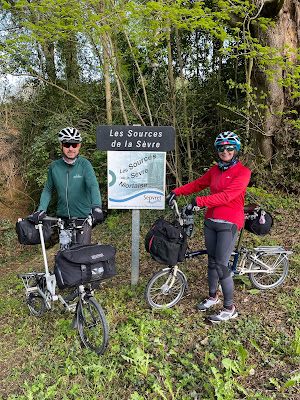
Fully loaded Bromptons at the source of the Sèvre Niortaise river


Day 1 – Sepvret to Niort 72kms


Ride With GPS route


Starting at the source of the Sèvre Niortaise river and following this as close as possible to Niort.  We pick up the newly created V94 in Exoudun.  


There is a bar in the square at Le Mothe-st-Héray (KM18) (the short detour to the Orangery as you arrive in town is recommended) and plenty of bars and restaurants in the military town of St-Maixent-l’Ecole (KM30).  Following the river closely, this route can get quite steep in places as you climb out of the valley, but the climbs are short and manageable.


Really good patisserie stop just before KM43 in La Creche.


The track sections from KM44 to KM50 are pretty good.


Pick up the Velo Francette at KM59 by the Château Coudray-Salbart dating from the Middle Ages, and follow this into Niort, avoiding the dogleg just after KM62.


Highly recommend the restaurant Douc’Heure De Maroc off Place Brèche run by a local Moroccan family.  Great value tajine.


French Village Diaries cycle-touring the Sèvre Niortaise, Atlantic coast and Charente
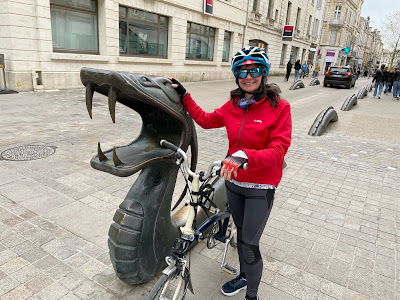
The dragon snakes of Niort


Don’t miss the famous bronze dragon snakes that rise from the pedestrian streets in Niort and the Franck Ayroles ladies on the bench in Les Jardins de la Brèche are worth a photo stop.


AirBnB accommodation very close to the covered market and Donjon. 


NOTE: All accommodation on this trip is ground floor and easily accessible for 2 people and their Bromptons.


French Village Diaries cycle-touring the Sèvre Niortaise, Atlantic coast and Charente
On the Vélo Francette in the Marais Poitevin


Day 2 - Niort to La Rochelle 100kms


Ride With GPS route


Leave Niort on the Velo Francette following the river all the way to Coulon at the entrance to the Marais Poitevin (KM17). The Marais Poitevin is the second largest wetlands site in France (after the Camargue) and a haven for wildlife. There are good bars and restaurants in Coulon – it can get busy in tourist season.  Perhaps stop and take a barque (punt boat) onto the marais but we prefer to do this from the less busy town of Arçais further on.  Leave the Francette and follow the easy and very pretty road to Irleau (KM23).  


Staying off the Francette follow the road and trail to Arçais at KM28.  The Francette avoids this town and it is such a shame as it is lovely.  Take a picnic on a barque from the embarquerie du martin pecheur.  A 1 hour rental at lunch time grants to an additional 45 minutes free to stop at their remote picnic island in the middle of the marais forest.


Continue to Damvix (KM32) more bars here.  Divert off the Francette again to Bazois (KM35). Then follow the Francette to Marans at KM 58.  This is a long section.


After Marans, we could smell the salty sea air as we continued to the coast where the Sèvre meets the Atlantic.  However, if you need to press on to La Rochelle then follow the Francette alongside the Napoleonic canal all the way into the centre of La Rochelle.  Pop into Dompierre-sur-Mer if you need a bar stop.


French Village Diaries cycle-touring the Sèvre Niortaise, Atlantic coast and Charente
The fabulous cycle routes approaching La Rochelle


We came inland from the coast as the coastal path is a bit tricky on tyres.  KM72 to 89 is a mix of easy road and great dedicated cycle tracks that are well used by the locals.


KM 89 to 91 joins a slightly busier road to skirt the runway at the airport, but it is perfectly safe.  Then join the wonderful cycle network through La Rochelle at KM92.  Using this route means you arrive into La Rochelle from the ocean side rather than from the land side.  There is one large industrial estate to bypass and look out for the large WW2 submarine pens in the port.  Then savour La Rochelle which has become a cycling wonderland and has to be one of the best cities in France. A visit to Café de la Paix is a must.


Apartment in ancient town house.


A nice idea here, if you have the time, would be to spend an extra night and cycle over the bridge to Ile de Ré. The highlights of the island can easily be covered in a day. The toll bridge is free to cyclists who have a dedicated path safely separated from the road. In high season the cycle paths on the island can get very busy.


French Village Diaries cycle-touring the Sèvre Niortaise, Atlantic coast and Charente
The Atlantic coast Vélodyssée


Day 3 – La Rochelle to Rochefort 65kms


Ride With GPS route


Leave La Rochelle following the coast on the well signposted EV1 Vélodyssée.


Sample the divert around Angoulins to follow the coast around this little headland at KM9.


Chatelaillon Plage (KM17) is a classic French seaside resort and has plenty of bars and restaurants.


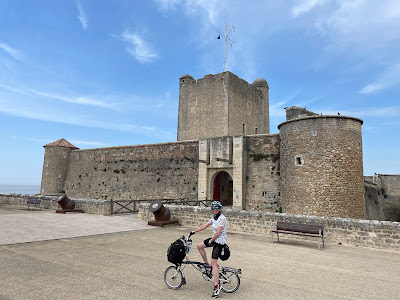
It is really worth diverting to Fouras at KM29.  The route into town follows the old deserted railway line and passes some of the traditional carelet fishing huts built on stilts in the water.  The town itself is lovely and sports a splendid Vauban fort guarding the entrance to the Charente river.


French Village Diaries cycle-touring the Sèvre Niortaise, Atlantic coast and Charente
Fort Vauban, Fouras, Flow Vélo


Leave Fouras and stick to the coastal path from KM38 to 42.  This is worth the detour although it can be narrow in places.  It was a highlight section of our trip.


Follow the EV 1 into Rochefort and around the edge of the Rochefort peninsula.  The cycle way here is very good.  Pass under the huge road bridge and arrive at the pont transbordeur at KM61.  It is the last bridge of its type in France and has been recently renovated.


French Village Diaries cycle-touring the Sèvre Niortaise, Atlantic coast and Charente
Pont Transbordeur, Rochefort


NOTE - If you are en route to Bordeaux via the EV1 we would recommend crossing the river here, on the pont, rather than following the official route to the east of Tonnay sur Charente.  Crossing the bridge is an experience not to be missed.  Then rejoin the EV1 just east of Echillais and follow it on the old railway line although a diversion to the fortified town of Brouage in the middle of the marais is a must and it is such a shame that it is bypassed by the EV1.


Today’s route ends in the royal dockyards at Rochefort.  Rochefort is a great town for travelling around in.  There is not much dedicated cycling infrastructure, but all roads are laid out on a grid iron pattern and every road gives way at every junction.  Plenty of one-way streets but almost all of them allow cycles to travel in both directions.  The courtesy and patience of the drivers in this town is lovely.


AirBnB apartment in a lovely old town house.


River Charente, Rochefort, Flow Vélo


Day 4 – Rochefort to Cognac 90kms


Ride With GPS route


This was a big day and was over six hours in the saddle despite taking some shortcuts.


The route follows the relatively new FlowVelo V92.  The trail sections are not all well surfaced until the outskirts of Cognac where they greatly improve. Public toilets and benches were a bit thin on the ground too.


The initial run out of Rochefort and through Tonnay sur Charente (KM7) follows really well-planned cycle paths alongside the main road. The old suspension bridge is worth a look although you will need good climbing legs to get up to crossing level.  It is open only to pedestrians and cyclists.  You would understand why if you crossed it…


From here the trail sections are variable with some very narrow or very rutted.  There are bypass routes following local roads which you could divert on to at many points. Don’t forget to look out for storks who arrive here for a summer of breeding.


French Village Diaries cycle-touring the Sèvre Niortaise, Atlantic coast and Charente
Saintes


Saintes at KM53 is a busy town but with all facilities.  Plenty of evidence of the Roman occupation here too.


At KM71 we finally had had enough of the variable quality trails and hit the road all the way to KM82 at Pres Menu where the trail surfaces get noticeably better.  This point marks the crossing from the Charente Maritime department into the Charente.  From now, all the way to Angouleme and beyond to Nontron, the trail sections on the Flow Vélo are superb.


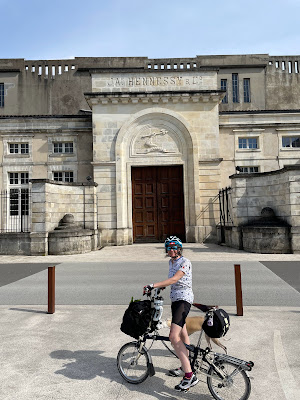
The final run into Cognac follows the old railway line and ends up at the main quay where you will find the impressive Hennessy cognac house. Many Cognac houses in the city offer guided tours.


Beware the roads in town are busy and the drivers are not too courteous.  It was quite a shock after La Rochelle and Rochefort.


Large open plan loft accommodation behind the park.


French Village Diaries cycle-touring the Sèvre Niortaise, Atlantic coast and Charente
Cognac, Flow Vélo


Day 5 – Cognac to Angoûleme 62kms


Ride With GPS route


The FlowVélo splits between these 2 cities.  We followed the northern route partly because it passes through the lovely town of Jarnac in time for a croissant and coffee.


A mixture of road and trail but all well signposted for the V92.  The trail after Jarnac from KM18 to KM36 via Chateauneuf is superb.  We had planned a divert onto the road to save some time but the trail was so good that we stayed on it.


French Village Diaries cycle-touring the Sèvre Niortaise, Atlantic coast and Charente
Wall art in Angoûleme


You can divert to the southern loop following the river at KM41 but we decided to follow the river and it is a nice section.  KM49 to 54 is a little busier with traffic but nothing serious before picking up the river trail at KM54 all the way into the city of Angouleme.  Angouleme is built on an outcrop of rock.  Plan your access.  The marked route is about the easiest we know at about 7% incline.  This can increase to stupid % on some of the other routes into the city.


French Village Diaries cycle-touring the Sèvre Niortaise, Atlantic coast and Charente
Le Bruleau Charentais, Angoûleme


If you like steak then there is only one place to head for your Entrecote aux Echalottes cooked over an open fire in the Bordealise fashion:  Le Bruleau Charentais on Rue de Beaulieu.  Fabulous and very reasonably priced restaurant.


AirBnB apartment in the centre of the city.


Great (cheap) coffee in the covered market at the Italian deli – don’t forget to buy your croissant from the boulangerie in the market halle first.


Getting here

There are TGV services from Paris Montparnasse or Lille to Poitiers, St-Maixent-l”Ecole, Niort, La Rochelle and Angouleme.  Ordinary train services to other major towns on the route.


Regular flights from various UK airports to La Rochelle or Poitiers.